

WallWear
wallwear.com
Overall Score
62/100
Needs WorkSEO
65/100
GEO
52/100
Summary
What's working well
- ✓ Strong product schema with GTINs on metal tile products, Organization schema with social profiles, and Google Search Console verified — a solid technical SEO foundation.
- ✓ The custom wallpaper calculator on product pages is a genuine differentiator — it reduces buyer anxiety around measurement and is the kind of unique, first-hand utility that builds brand trust.
- ✓ Compelling founder story (Jan McCallum, 20+ years; son Neil McCallum continuing the brand) on the About page — exactly the kind of entity clarity that builds AI knowledge graph recognition and customer trust.
Critical issues
- ⚠ The blog section exists but has zero published articles. This is the single biggest missed opportunity — no content means no organic discovery, no AI citation, and no reason for repeat visits.
- ⚠ No email marketing platform detected (no Klaviyo, Omnisend, or equivalent). With paid traffic across Pinterest, TikTok, Facebook, and Google Ads, there is no mechanism to capture and re-engage that spend.
- ⚠ Zero upsell or cross-sell touchpoints in the cart or post-purchase flow. Customers who buy one wallpaper roll are never shown related panels, tiles, or complementary SKUs — leaving significant average order value on the table.
Growth opportunity
WallWear has the ingredients of a strong brand — a genuine founder narrative, a differentiated product calculator, and solid multi-channel paid presence. The gap is in the compounding channels: content, email, and post-purchase revenue. Publishing even 8–10 genuinely useful installation and design guides in the blog would drive organic traffic and give AI systems something concrete to cite. Pairing that with a properly configured email platform and cart upsells could realistically lift revenue per visitor by 20–35% without increasing ad spend.
Store Screenshots


Per-Page Issues
| Page | Issue | Category | Severity | Recommendation |
|---|---|---|---|---|
| Global | No email marketing platform detected. Pinterest, TikTok, Facebook, and Google Ads pixels are firing, but there is no Klaviyo, Omnisend, or equivalent email/SMS tool to capture and nurture that traffic. | CRO | 🔴 Critical | Install Klaviyo (free up to 250 contacts). Set up a welcome series, abandoned cart flow, and post-purchase sequence. |
| Blog / News | Blog exists at /blogs/news but has zero published articles. The sitemap references the blog but with no content, it contributes nothing to organic discovery or AI citation eligibility. | GEO / SEO | 🔴 Critical | Publish 8–10 installation guides and design-inspiration articles. Topics like "How to install peel and stick wallpaper in a rental" have high search intent and zero competition for this brand. |
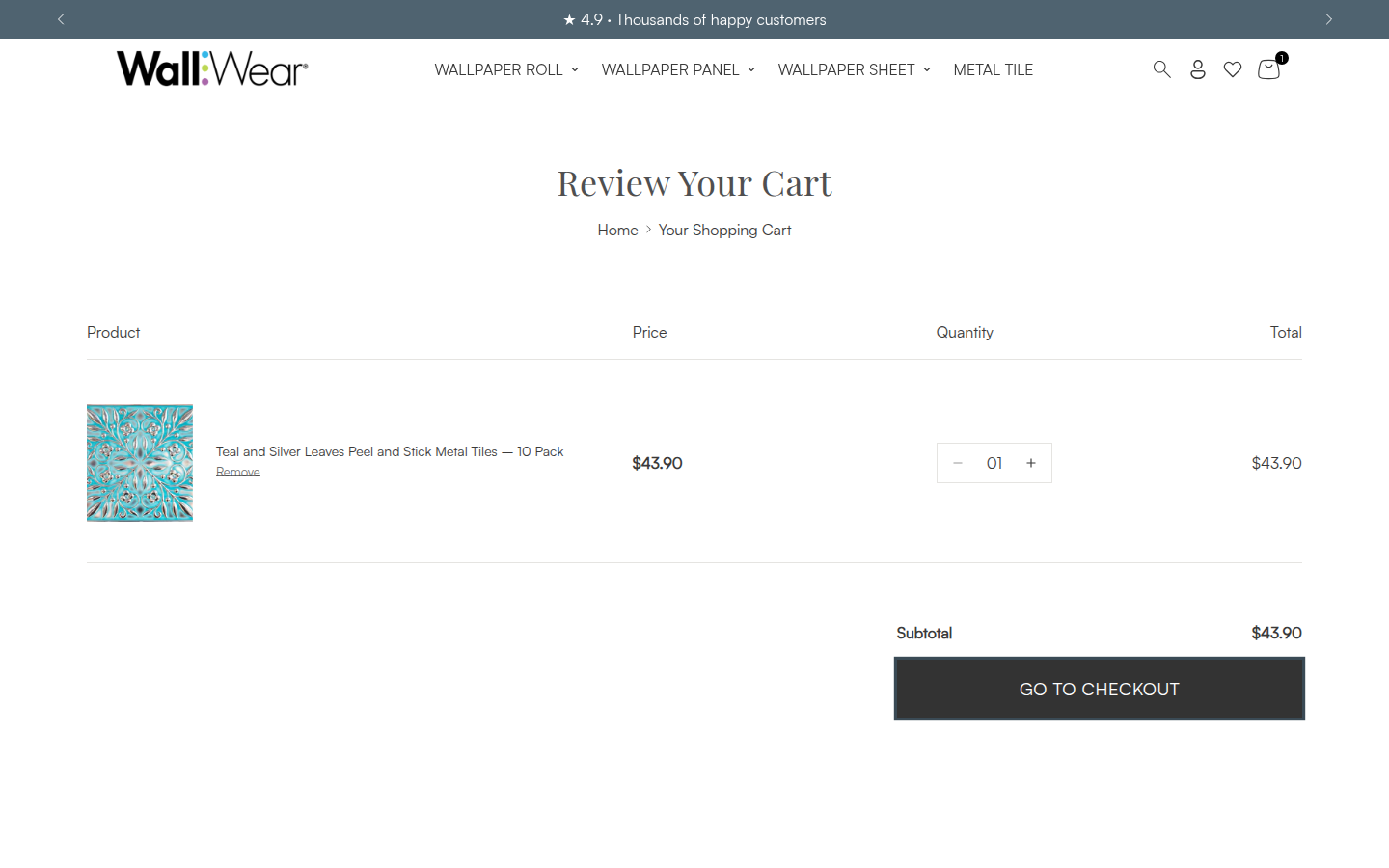
| Cart | No cart upsell or cross-sell block. Cart page shows products and a free shipping bar but makes no recommendation for complementary items (e.g., tiles + wallpaper roll bundles). | CRO | 🔴 Critical | Add a "Complete the look" cart upsell block using Shopify's native product recommendations API or an app like ReConvert / Zipify. |
| Product pages | AggregateRating is missing from Product schema on all product pages. Reputon shows Amazon-imported star ratings, but these don't feed back into the schema, so Google cannot surface stars in search results. | Technical / SEO | 🟡 Warning | Configure Judge.me to output native product review widgets and ensure aggregateRating is written to Product schema. This unlocks rich result star snippets in Google Search. |
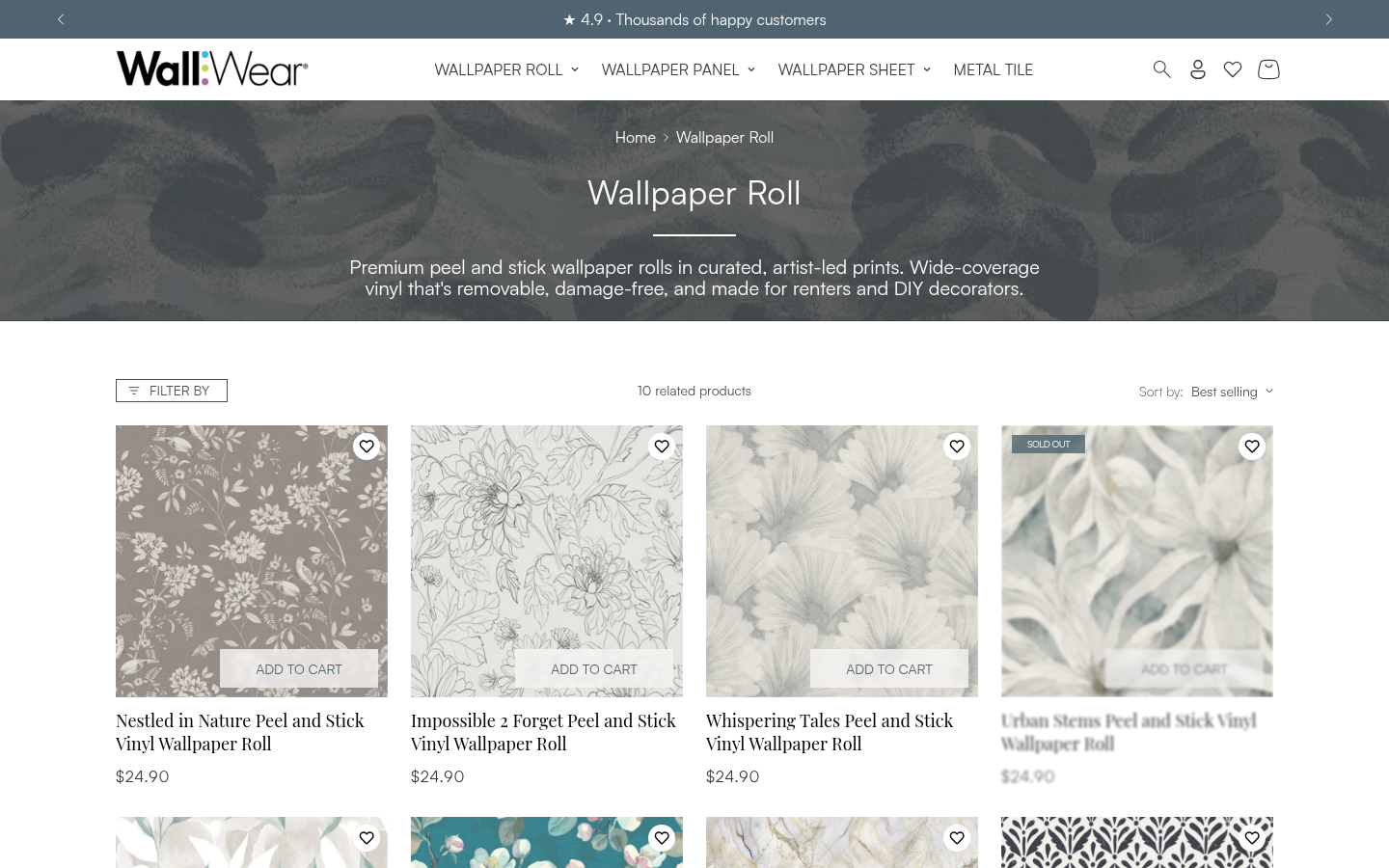
| Wallpaper Roll products | GTIN field is missing from Product schema on wallpaper roll products (confirmed on "Nestled in Nature" roll). Metal tile products have a valid GTIN (816976035928). Inconsistency weakens Google Shopping eligibility. | Technical / SEO | 🟡 Warning | Add GTIN/barcode values to all wallpaper roll products in Shopify admin. This is required for Google Shopping free listings and Merchant Center feeds. |
| FAQs page | The /pages/faqs page has structured FAQ content but no FAQPage schema markup. Google can't extract and surface these Q&As as rich results, and AI systems lose a structured answer source. | Technical / GEO | 🟡 Warning | Add FAQPage JSON-LD schema to /pages/faqs. Eligible questions (e.g., "Is peel and stick wallpaper safe for rental walls?") can appear directly in AI Overviews and search results. |
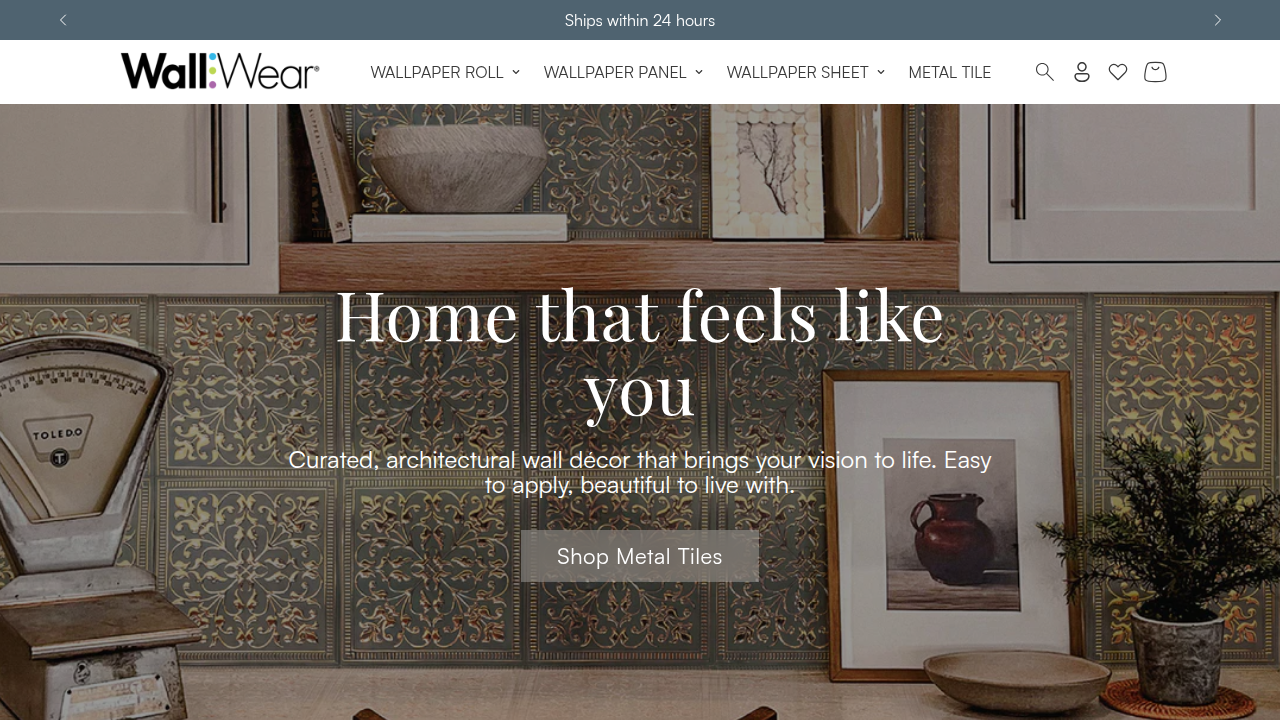
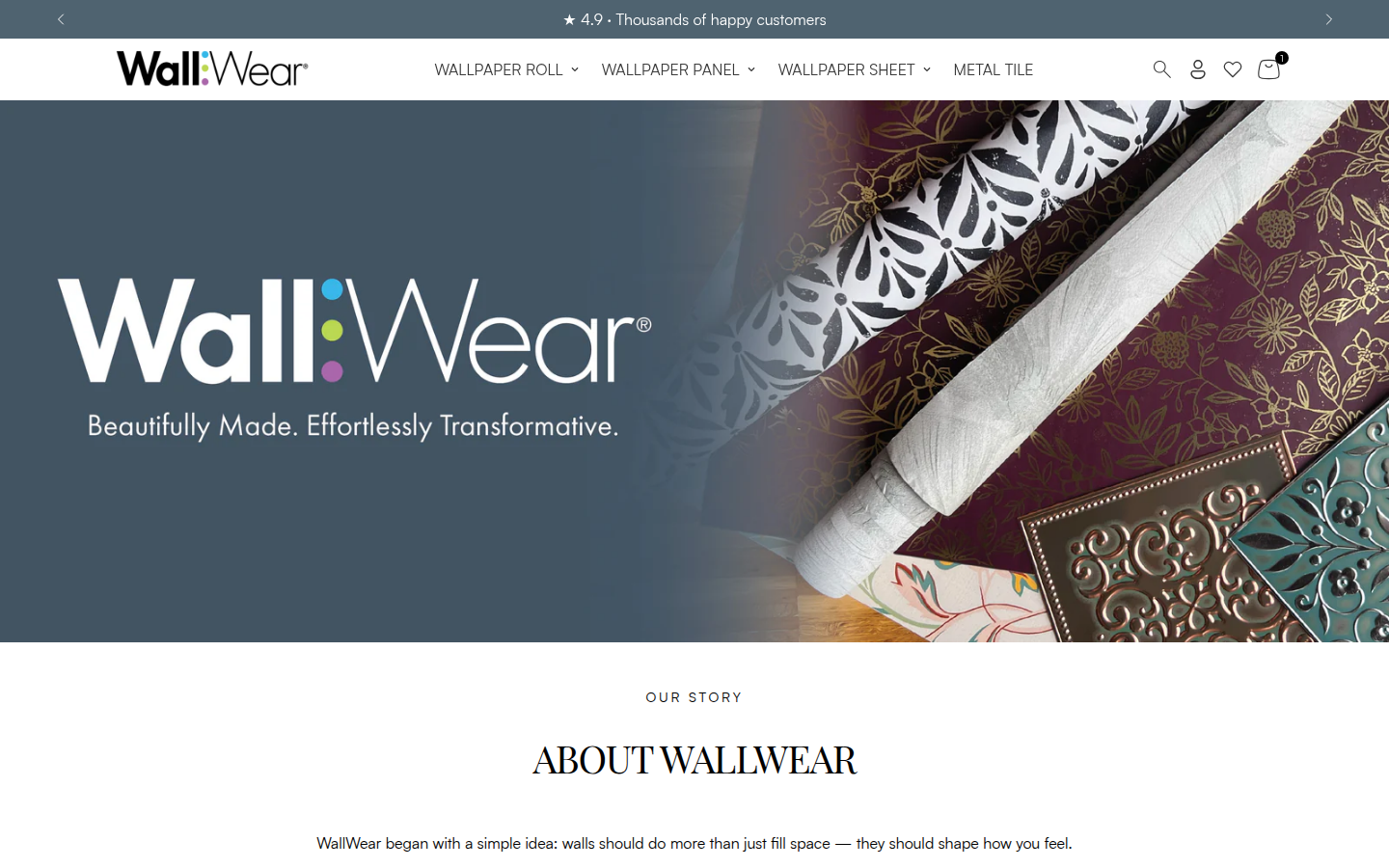
| Homepage | Hero slider image has a generic, auto-generated alt text: "slider image slider_item_qXaBwg". This is the most prominent image on the page and provides no descriptive context to crawlers or screen readers. | Technical / SEO | 🟡 Warning | Update the hero slideshow images with descriptive alt text in the theme editor (e.g., "WallWear peel and stick botanical wallpaper on a living room accent wall"). |
| Homepage | Meta description ("WallWear a wall décor company that designs and produces high-quality trend-setting products at accessible prices.") is weak, grammatically incomplete, and fails to communicate the brand's unique selling point. | SEO / GEO | 🟡 Warning | Rewrite to something like: "WallWear — artist-designed peel and stick wallpaper, panels, and metal tiles. Renter-friendly, tool-free installation. Ships within 24 hours from the USA." |
| Homepage / OG | Open Graph image on the homepage is the WallWear logo (600×600px), not a lifestyle product photo. When the page is shared on social, the preview shows a logo instead of an aspirational room shot. | SEO / CRO | 🟡 Warning | Replace the OG image with a high-impact lifestyle photo showing the product installed in a real home. Minimum 1200×630px. |
| Organization schema | Organization schema is missing foundingDate and founder/person details despite the About page having this information. Google Knowledge Graph relies on this structured data for entity recognition. | GEO / Technical | 🟡 Warning | Add foundingDate, founder (Person schema for Jan McCallum), and knowsAbout fields to the Organization JSON-LD block. |
| Global | 13 product/UI images across key pages have empty or non-descriptive alt text (alt=""). These are missed SEO signals and accessibility failures. | Technical / SEO | 🟢 Info | Audit product images in the Shopify admin and add descriptive alt text to all product gallery images. Shopify makes this easy in Files > Image alt text. |
| Homepage | 32 external JavaScript files and 28 CSS stylesheets load on the homepage. The featured-collection.js asset is loaded twice (duplicate script tag). This adds unnecessary page weight and increases load time. | Technical | 🟢 Info | Remove the duplicate featured-collection.js script reference in theme settings. Consider auditing which theme sections are actually used on each template and lazy-loading the rest. |
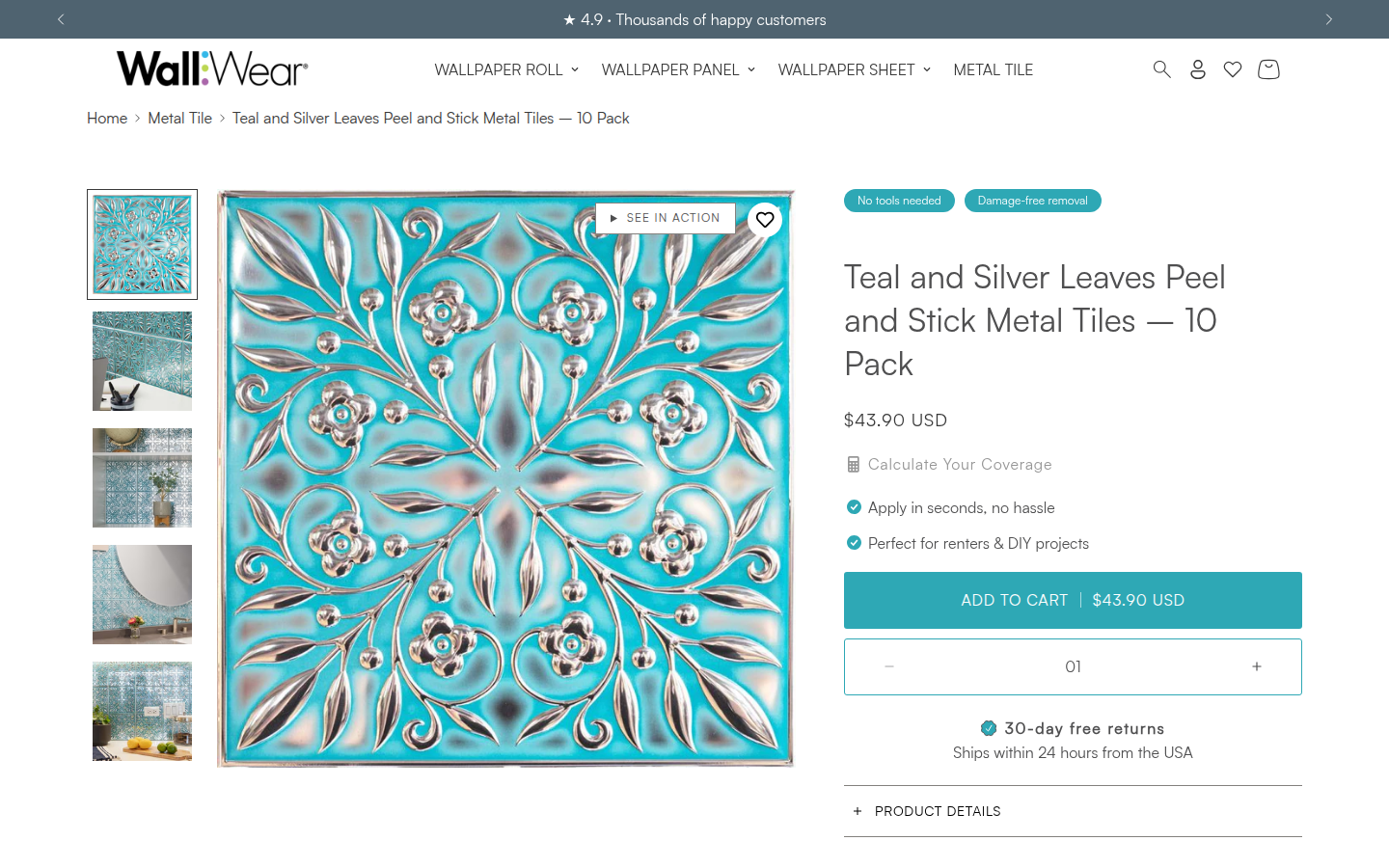
| Product pages | No cross-sell or related product section on PDPs. Customers viewing the Teal & Silver Leaves tile are not shown other tile patterns, wallpapers that would complement it, or bundle suggestions. | CRO | 🟢 Info | Enable Shopify's built-in product recommendations section in the Minimog theme settings, or use the product_recommendations Liquid object to surface related items below the fold. |
| Cart page | Cart page has no H1 tag. While minor for SEO, it's an accessibility gap and means no cart-page heading for screen reader users. | Technical / UX | 🟢 Info | The current "Review Your Cart" heading appears to render outside an H1 element. Ensure it is marked up as an H1 in the cart template. |
GEO — Generative Engine Optimization
52
/ 100
WallWear has the brand identity signals that AI systems look for — a named founder, a genuine origin story, and a distinctive product niche. What it lacks is the content depth that would make it citable. An empty blog, thin product descriptions that stop short of genuine expertise, and missing structured data all reduce the likelihood of appearing in AI-generated answers about peel-and-stick wallpaper.
9-Dimension Assessment
Non-Commodity Content Quality
Product descriptions communicate features well ("grey background adorned with delicate light floral illustrations") but stop short of genuine first-hand expertise. No content answers real installation questions, no comparisons to traditional wallpaper, no design advice from Jan or Neil McCallum. The blog — the natural home for non-commodity content — has zero articles. This is the highest-weight GEO dimension and the weakest area.
30/100
Entity Clarity & Brand Authority
Strong relative to store size. The About page names the founder (Jan McCallum, classically trained oil painter, 20+ years), the successor (Neil McCallum, graphic arts background), and a clear mission. Organization schema with social profiles (Facebook, Instagram, Pinterest, TikTok) is present. Weaknesses: no press coverage, no awards, no third-party citations visible, and the Organization schema lacks foundingDate and founder structured data.
60/100
Technical Crawlability & Indexing
Excellent. robots.txt allows all key page types (products, collections, pages, blogs). No noindex or nosnippet directives found on any audited page. Sitemap is well-structured with separate product, page, collection, and blog sitemaps. No AI crawlers (GPTBot, ClaudeBot, PerplexityBot) are blocked. Google Search Console is verified.
88/100
Content Structure & Semantic HTML
Product pages have a clear H1 (product name) and use H2/H3 to break up sections (Wallpaper Calculator, Key Features, Product Specifications). However, the heading hierarchy places H3 "Search our store" (the search drawer) before the H1, which is a structural quirk. Collection pages are well-structured. No FAQ content on product pages — a missed opportunity for schema and AI extraction.
62/100
Structured Data (Supporting Role)
Organization, WebSite, BreadcrumbList, CollectionPage, ItemList, and Product schemas are all present. Product schema includes SKU and brand. Metal tile products have a GTIN. What's missing: AggregateRating on all products, GTIN on wallpaper rolls, FAQPage schema on the FAQs page, and founder/Person details in Organization schema.
65/100
Multimodal Readiness
Product images are high-quality and multiple per product (5–7 images on the metal tile PDP, including lifestyle and detail shots). However, 13 images across key pages have empty alt text, and the hero slider's alt attribute is auto-generated ("slider image slider_item_qXaBwg"). No product videos detected. Image filenames from the CDN are not descriptive (e.g., "MetalTile_2500x2500_TealSilver_05.jpg" is acceptable, but most are UUID-based).
55/100
Query Fan-Out Readiness
The store has natural topic coverage across product types (roll, panel, sheet, tile). The wallpaper calculator answers the "how much wallpaper do I need?" query directly. However, there is no content addressing common decision-making queries: "peel and stick vs traditional wallpaper", "is peel and stick safe for textured walls", "how to remove peel and stick wallpaper without damage". Without a blog, these queries have nowhere to land.
40/100
Google Merchant Center & Business Profile
Google Ads tracking (AW-17815445335) and Google Tag (GT-W6XCNWTM) are active, suggesting some level of Google Ads integration. However, no evidence of a Google Merchant Center product feed was found. Wallpaper roll products are missing GTINs, which would block free Shopping listings. No Google Business Profile is applicable (online-only store).
45/100
Agentic Experience Readiness
Impressive early adoption: robots.txt references agents.md, and the store exposes a UCP/MCP endpoint at /.well-known/ucp (Shopify's Universal Commerce Protocol for AI agents). The store's DOM structure is clean with 88 ARIA labels. Add-to-cart buttons and interactive elements are accessible. The main gap is missing aggregateRating data that an agent would use to assess product quality.
72/100
Prioritized GEO Actions
| Action | Difficulty | Impact |
|---|---|---|
| Publish 8–10 installation and design-advice articles in the blog — written from genuine first-hand experience, not generic tips (e.g., "What we learned testing 11 peel-and-stick adhesives on textured walls") | Medium | High |
| Add FAQPage schema to /pages/faqs and expand FAQ content on product pages (6–8 installation/care questions per product type) | Easy | High |
| Configure Judge.me to render product review widgets, which will populate AggregateRating in Product schema and unlock star snippets in Google Search | Easy | High |
| Rewrite homepage meta description to be specific and compelling — include the product category, key differentiator (renter-friendly, peel-and-stick), and a brand signal | Easy | Medium |
| Add GTIN barcodes to all wallpaper roll and sheet products in Shopify admin to enable Google Merchant Center free listings and rich Product results | Easy | Medium |
| Enrich Organization schema with foundingDate ("2004"), founder Person schema (Jan McCallum), and knowsAbout fields to strengthen Knowledge Graph candidacy | Easy | Medium |
| Replace hero slider auto-generated alt text with descriptive copy — "WallWear botanical peel-and-stick wallpaper roll installed on a light grey accent wall" | Easy | Medium |
| Add product videos showing installation process — 60-second install demos are highly citable by AI systems and perform strongly on social channels already active (TikTok, Instagram) | Medium | Medium |
What not to do — common GEO myths
- llms.txt files: Google has explicitly stated you do not need to create llms.txt or any special AI text files to appear in generative AI features. The store already has an agents.md (via robots.txt) — that is sufficient for Shopify's UCP infrastructure.
- Chunking content for AI: Do not break product descriptions into tiny fragments thinking this helps AI parse them. Google's systems understand full pages just fine — depth and originality matter more than format.
- Long-tail keyword stuffing: Rewriting product pages to include phrases like "best peel and stick wallpaper for renters 2026" will not improve GEO. Write for real customers, not keyword variations — AI understands synonyms and context.
- Seeking fake mentions: Trying to get the brand cited across low-quality directories or AI-generated articles will not improve AI visibility and risks triggering spam signals.
CRO Scorecard
Stage 1
Awareness
62/100
- Pass Strong visual branding — warm off-white (#F7F6F2) backgrounds, slate teal CTAs (#4F6370), Playfair Display headings create a premium, design-conscious aesthetic consistent with target audience.
- Pass Product category hierarchy is clear in the mega menu: Metal Tile, Wallpaper Roll, Wallpaper Panel, Wallpaper Sheet — each with style and color sub-filters.
- Pass Multi-channel paid ad presence (Pinterest, TikTok, Facebook/Meta, Google Ads) shows active top-of-funnel investment.
- Partial Homepage hero slider has good lifestyle imagery but generic alt text and no explicit value proposition headline in the H1 — the brand name does the heavy lifting where a benefit statement would convert better.
- Fail No blog content. Organic discovery channels are entirely absent — all acquisition is paid. No social proof counter ("trusted by X customers"), no press mentions, no review count visible above the fold.
Stage 2
Consideration
65/100
- Pass Collection pages have strong meta descriptions and clear H1 headings. The collection description for Wallpaper Roll ("Premium peel and stick wallpaper rolls in curated, artist-led prints") is concise and benefit-focused.
- Pass Filter/sort functionality is present — by style category (Botanical, Floral, Modern, Traditional, Abstract) and color. This is well-executed for a home décor store.
- Pass Wishlist and product compare features are available (theme built-in), supporting longer consideration cycles typical of home décor purchases.
- Partial Review stars do not appear on collection product cards. Customers can't quickly identify top-rated products while browsing — a meaningful friction point for consideration.
- Fail No how-to video content visible on the site. For a product category where installation confidence is a key purchase barrier, video demonstrations would significantly reduce hesitation.
Stage 3
Purchase
70/100
- Pass Wallpaper calculator on every product page is a genuine conversion booster — it solves the "how much do I need?" anxiety that causes cart abandonment in this product category.
- Pass Sticky add-to-cart bar, free shipping threshold bar ($50 / $30 on some products), low-stock urgency signals, and "Ships within 24 hours from the USA" trust signal are all present and well-placed.
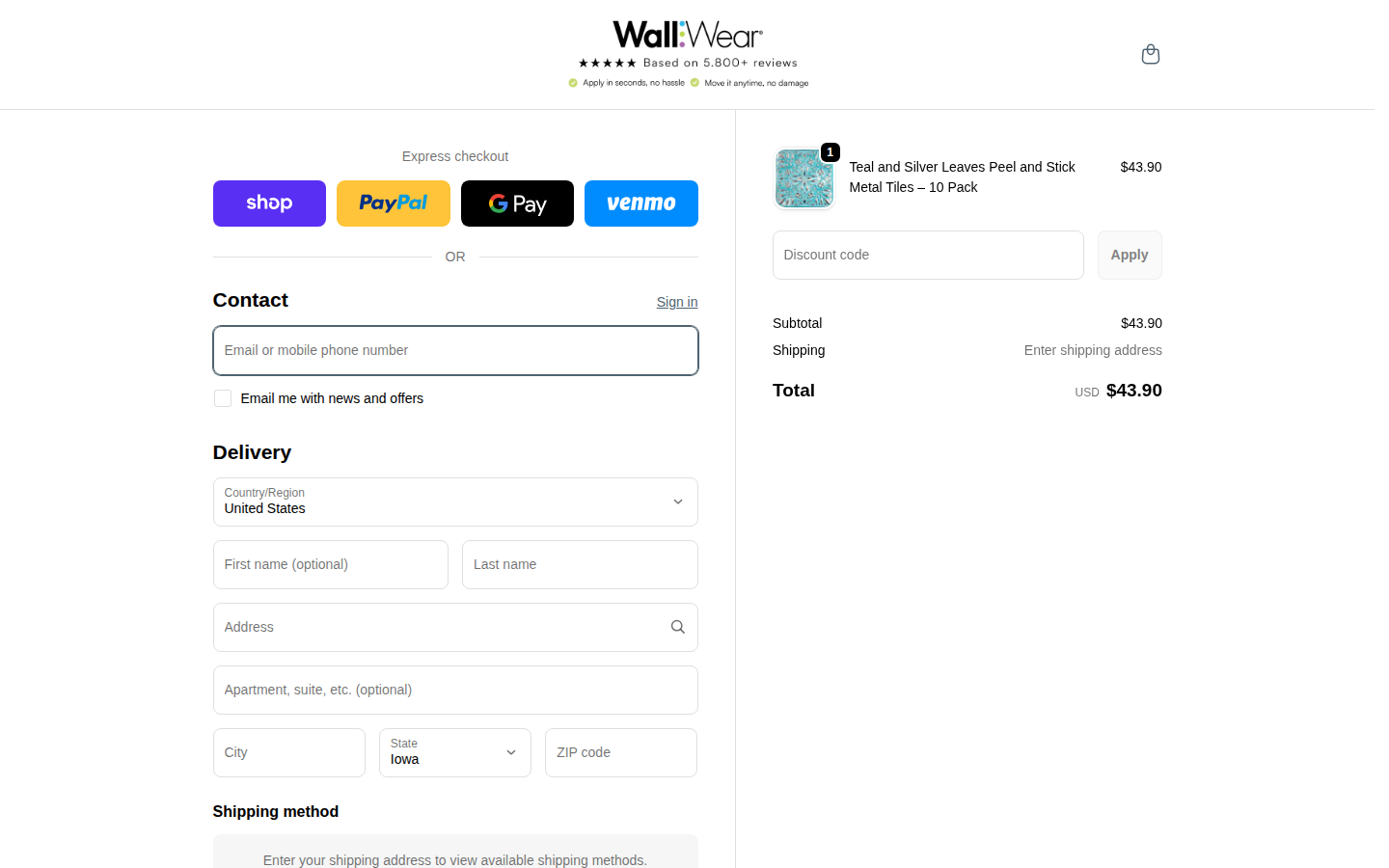
- Pass Checkout progressed successfully through Shopify's standard flow. Standard checkout fields (name, address, email, payment). Shop Pay and credit card payment options available. 30-day returns stated.
- Partial Reviews show Amazon-imported ratings via Reputon app, not real WallWear customer reviews with photos. These lack the authenticity that drives purchase confidence — a buyer can tell the difference.
- Fail No upsell, bundle, or "frequently bought together" block on product pages. A customer buying a wallpaper roll is never shown matching panels, tiles, or adhesive accessories — AOV is left unrealized.
Stage 4
Retention
30/100
- Pass Newsletter signup in footer is present. An Instagram feed section (GSC Instafeed) keeps the site visually fresh and encourages social follows.
- Fail No email marketing platform detected anywhere in the site source. The newsletter form captures email addresses, but without a connected platform (Klaviyo, Omnisend), those emails go nowhere.
- Fail No post-purchase upsell or cross-sell. After a customer completes checkout, there is no thank-you page upsell, no product bundle offer, and no incentive to buy the next product in a room project.
- Fail No loyalty or rewards program. Repeat customers have no incentive structure — no points, no referral rewards, no exclusive early-access to new designs.
- Fail No live chat or customer support widget. For a product with installation questions, the absence of real-time support increases abandonment and reduces post-purchase confidence.
App Stack Audit
| App | Purpose | JS Impact | Est. Cost | Verdict | Savings |
|---|---|---|---|---|---|
| Judge.me Reviews | Product reviews & ratings — currently installed but review widgets not visibly rendering on PDPs | Low | Free / $15/mo | Keep + Fix | — |
| Reputon Amazon Reviews | Imports Amazon reviews carousel + star widget — not genuine WallWear customer reviews | Medium | ~$5.99/mo | Remove | $5.99/mo |
| GSC Instagram Feed | Instagram gallery widget — shows @_wallwear feed on the homepage and product pages | Medium | ~$0–10/mo | Keep | — |
| Shopify Forms | Native Shopify contact and email capture forms | Low | Free | Keep | — |
| Pinterest Ads Pixel | Pinterest conversion tracking (advertiser 126605) | Low | Free | Keep | — |
| TikTok Pixel | TikTok conversion tracking (pixel D51GLORC77UB50R0N3R0) | Low | Free | Keep | — |
| Meta (Facebook) Pixel | Facebook/Instagram conversion tracking (pixel 1312831653646969) | Low | Free | Keep | — |
| Google Ads + Tag | Google Ads conversion (AW-17815445335) + Google Tag (GT-W6XCNWTM) | Low | Free | Keep | — |
| Klaviyo (missing) | Email marketing — newsletter captures go nowhere without a connected platform | Low | Free–$45/mo | Install | — |
| Cart Upsell app (missing) | In-cart cross-sell and post-purchase upsell — zero upsell revenue currently | Low | $15–$30/mo | Install | — |
| Total Potential Savings | $5.99/mo / $71.88/yr | ||||
App stack recommendation
Remove Reputon Amazon Reviews ($5.99/mo) and replace with properly configured Judge.me review widgets — actual WallWear customer reviews with photos will dramatically outperform imported Amazon reviews for conversion and SEO. The bigger lever is installing Klaviyo (free for up to 250 contacts) and a cart upsell app. Even a 5% email capture rate converting at 2% would generate more incremental revenue than the $5.99 saved — the math is strongly in favor of investing here.
Theme & Code Quality
Theme
Minimog — OS 2.0
Version 5.8.0 · Custom name "Aloft. | WallWear" · Shopify Online Store 2.0 compatible
Code Health
68/100
Technical Debt Items
- Notable Duplicate script tag: featured-collection.js (v165760156732424705711777387177) is referenced twice in the homepage source. This loads the script twice, wasting bandwidth and potentially causing initialization conflicts. Remove the duplicate in the theme Liquid templates.
- Notable Heavy script count: 32 external JavaScript files and 28 CSS files on the homepage. Minimog's modular architecture loads per-section assets, which is good in principle, but many of these may be loading on templates where they're not needed (e.g., cart.js loading on the homepage).
- Notable Third-party app JS on every page: Reputon Amazon Reviews loads two separate scripts (reputon-amazon-carousel-widget.js and reputon-amazon-stars-product-widget.js) on product pages, adding extra JS weight. Removing this app reduces script load meaningfully.
- Minor Custom font loading: The store uses a custom "Satoshi" font (M-Body-Font) loaded from Shopify CDN as .ttf files (light and regular weights). .ttf format is less efficient than .woff2 for web delivery. If the font source can be converted to woff2, page load will improve slightly.
- Minor Hero image delivered at 3840px width: The main banner (WallWear_MainBanners_Desktop.jpg) is served at up to 3840px wide. While Shopify's CDN does provide width-based variants via srcset, the declared largest size is very high. Confirming the responsive breakpoints are well-tuned will prevent unnecessary data transfer on standard desktop displays.
- Minor 46 inline script blocks on homepage: The high count of inline scripts (largely from Shopify theme components, section settings, and app injections) increases HTML payload size. Some of these could be moved to deferred external files for better caching.
- Good Minimog OS 2.0 v5.8.0 is a well-maintained theme: Online Store 2.0 architecture, section/block customization, JSON templates — all current. No deprecated Liquid filters or API usage detected. The theme is actively developed and the version is recent.
Brand Identity
Logo

Color Palette
#4F6370
Primary / CTA
#F7F6F2
Background
#3A3A3A
Body text
#72A72F
Free ship bar
#E5E4E1
Border / rule
Brand Consistency
Typography
GoodPlayfair Display (headings) + Satoshi (body) is an elegant and on-brand pairing for a design-forward décor brand. Consistent across all pages audited.
Color Consistency
GoodSlate teal (#4F6370) CTAs, warm off-white backgrounds, and charcoal text are applied consistently. Color system is well-defined in CSS custom properties.
Imagery Style
Needs WorkProduct photography mixes studio shots and lifestyle imagery inconsistently. Some products have room-in-use shots while others only show the pattern flat. Standardizing the lifestyle image format would elevate perceived quality.
Tone of Voice
Needs WorkProduct names ("Meet Cute", "Storybook Romance", "Nestled in Nature") are charming and on-brand. However, product descriptions are functional rather than evocative — they describe features but rarely tell a design story.
Logo Quality
GoodSVG favicon available. Logo is clean and legible at multiple sizes. Dark logo renders well on light backgrounds; light version would benefit from inclusion for dark-mode contexts.
Social Presence
GoodActive on Facebook, Instagram (@_wallwear), Pinterest, and TikTok (@_wallwear). All 4 channels linked in Organization schema. The Instagram feed widget on-site reinforces social credibility.
Growth Roadmap
Fix today — zero or near-zero cost
- Rewrite the homepage meta description to include the product category, key differentiator (peel-and-stick, renter-friendly), and a brand signal (ships from USA in 24 hours).
- Update the hero slider alt text from the auto-generated "slider image slider_item_qXaBwg" to a descriptive, keyword-rich caption in the Minimog theme editor.
- Add FAQPage JSON-LD schema to /pages/faqs — this is a code snippet you can add to the page template in the Shopify theme editor in under 30 minutes.
- Fix the duplicate featured-collection.js script tag in the theme templates to reduce unnecessary page weight.
- Enable Judge.me review widget display on product pages (it's installed but not rendering visible reviews) — this immediately adds social proof and feeds AggregateRating to Product schema.
- Add GTIN/barcode values to all wallpaper roll and sheet products in Shopify admin for Google Merchant Center eligibility.
Key investments — meaningful lift expected
- Install Klaviyo and connect it to the existing newsletter form. Create a welcome series (3 emails), an abandoned cart flow, and a post-purchase design inspiration email with complementary products.
- Add a cart upsell block — use Shopify's native product recommendations API in the cart template or a lightweight app. Show complementary items (e.g., a tile buyer seeing matching wallpaper).
- Remove Reputon Amazon Reviews and redirect that budget to generating real WallWear customer reviews with photos through Judge.me's review request emails.
- Replace the OG homepage image from the logo to a hero lifestyle photograph — this immediately improves social sharing previews across all channels.
- Enrich Organization JSON-LD with foundingDate, founder (Person schema for Jan McCallum), and knowsAbout fields to strengthen Knowledge Graph candidacy.
- Publish the first 4 blog articles — focus on installation guides where WallWear has genuine first-hand knowledge: "How to apply peel-and-stick wallpaper on textured walls", "Removing peel-and-stick wallpaper without damage".
Build for compounding returns
- Build a content engine around the blog: 2 articles per month covering installation, design trends, before/after room transformations, and product comparisons. This is the primary lever for organic traffic and AI citation.
- Add short-form product installation videos (60–90 seconds) to the most popular product pages. These are strong conversion assets and highly shareable on TikTok and Instagram Reels, where the brand is already active.
- Set up Google Merchant Center with a complete product feed including GTINs, accurate pricing, and high-quality images — this enables free Google Shopping listings and signals to Google's AI systems that the store is a merchant of record.
- Introduce a loyalty program (e.g., Smile.io free tier) to give repeat buyers points and referral incentives — particularly valuable for a product category where people redecorate seasonally.
- Add a product bundle builder so customers can plan a full room (wallpaper roll + panel + accent tile) in a single shopping session, increasing average order value meaningfully.
- Pursue press coverage and interior design blog features — being cited in HomeAdvisor, Apartment Therapy, or Houzz would generate high-authority backlinks and strengthen the brand's entity recognition in AI systems.