

Main Street
mainstcreations.com
Overall Score
62/100
Needs WorkSEO Score
63/100
GEO Score
58/100
Summary
Top Strengths
- ✓ Strong brand story — artist-founded in 2003 by Jan McCallum with a compelling About page, 20+ years of heritage, and eco-conscious positioning that differentiates from commodity competitors.
- ✓ Active blog with 48 articles featuring SEO-targeted titles like "Does Peel & Stick Wallpaper Work on Textured Walls?" — building organic traffic and topical authority in the peel-and-stick niche.
- ✓ Ahead-of-the-curve agentic commerce readiness — the robots.txt exposes UCP/MCP endpoints, an agents.md file, and llms.txt, positioning the store well for AI-driven shopping assistants.
Critical Issues
- ⚠ The homepage H1 tag is completely empty. This is the single most important on-page SEO element and its absence signals to Google that the page has no primary subject — directly hurting rankings and AI snippet eligibility.
- ⚠ Cart is missing a free shipping progress bar and upsell offers entirely. With a $50 free shipping threshold, the absence of a progress bar leaves conversion money on the table at the highest-intent moment.
- ⚠ Product pages are missing AggregateRating in their structured data — meaning customer reviews, despite appearing on the page, are invisible to Google for rich snippet stars and AI recommendation features.
Growth Opportunity
Main Street has genuine competitive advantages — 20 years of heritage, an artist-founded origin story, PVC-free materials, and a real content program — but these aren't fully translating into search visibility or conversions yet. Fixing the empty H1, wiring up AggregateRating schema, and adding a cart upsell flow could realistically increase revenue 8–15% without any new traffic. The brand has the raw ingredients for strong GEO performance; the gaps are mostly technical oversights rather than fundamental problems.
Screenshots
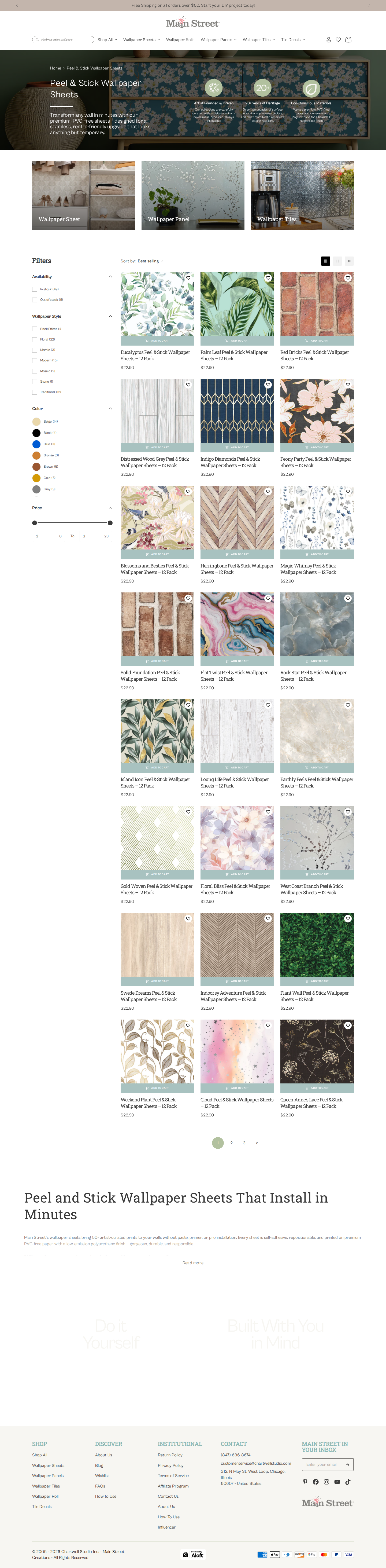
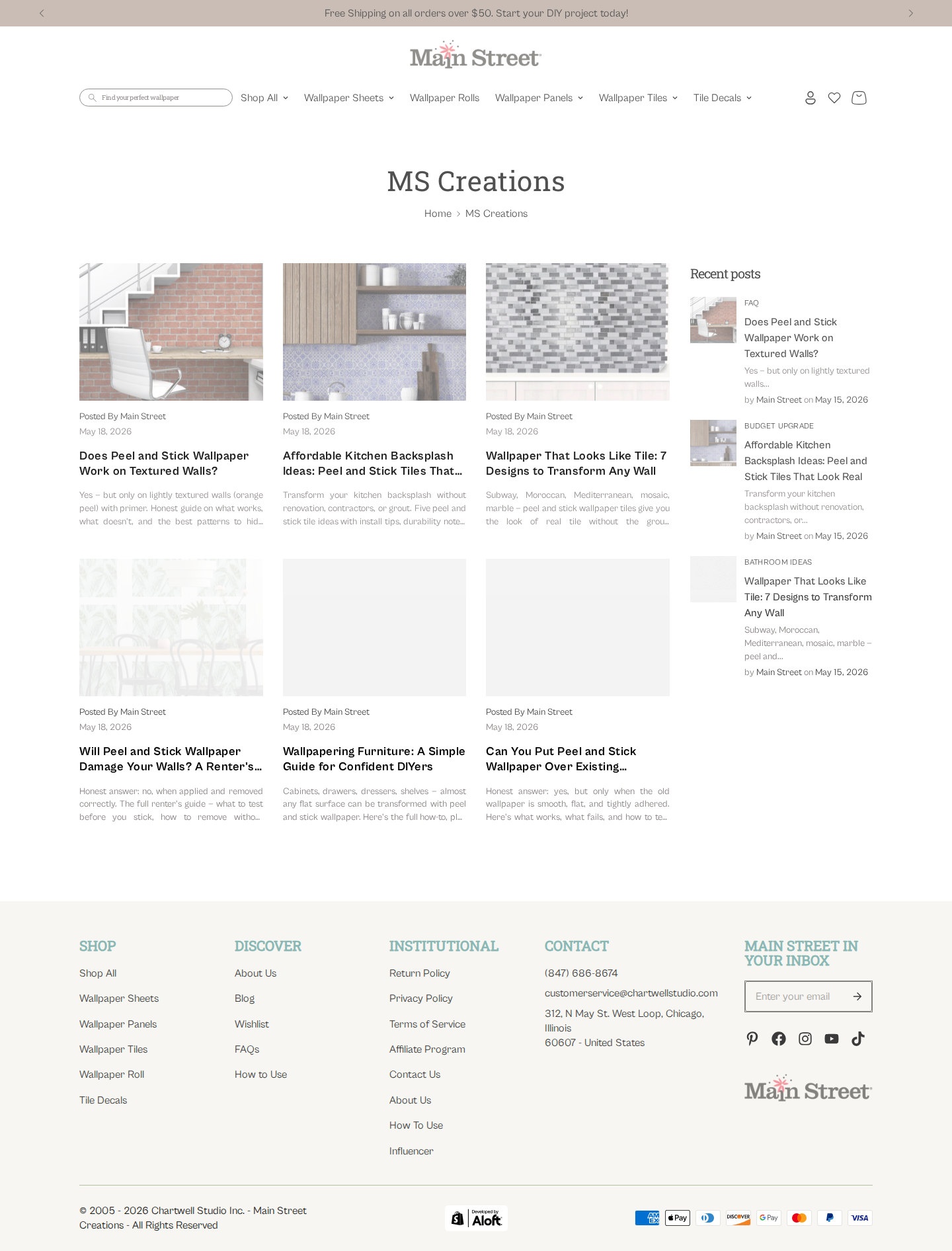
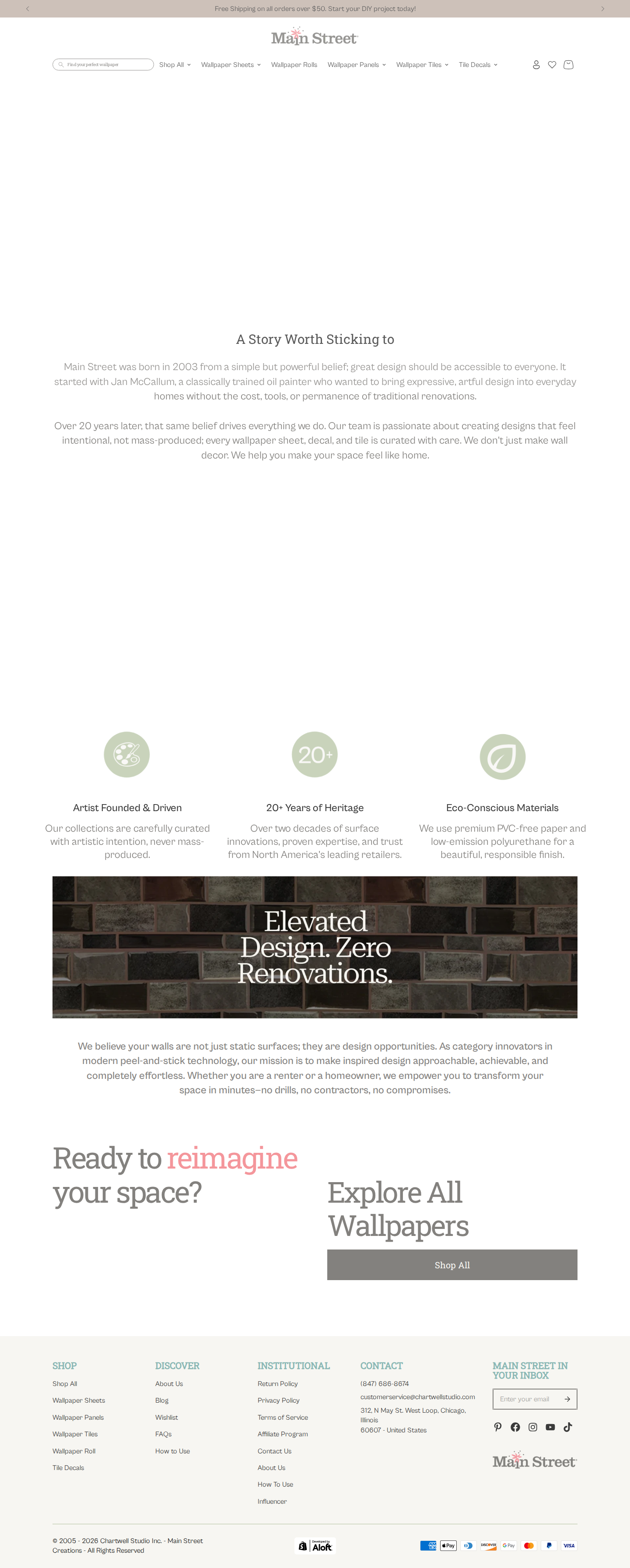
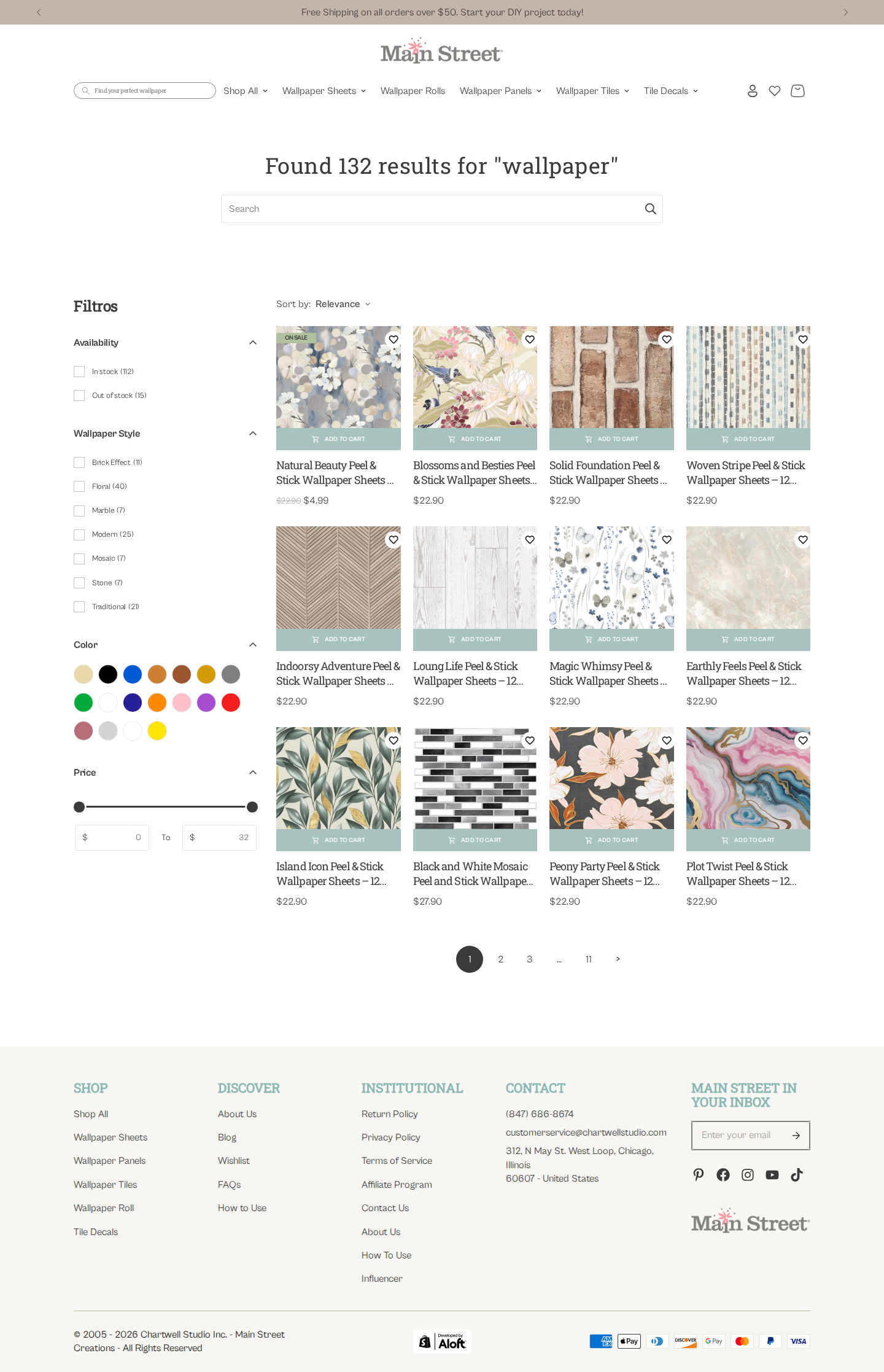


Per-Page Issues
| Page | Issue | Category | Severity | Recommendation |
|---|---|---|---|---|
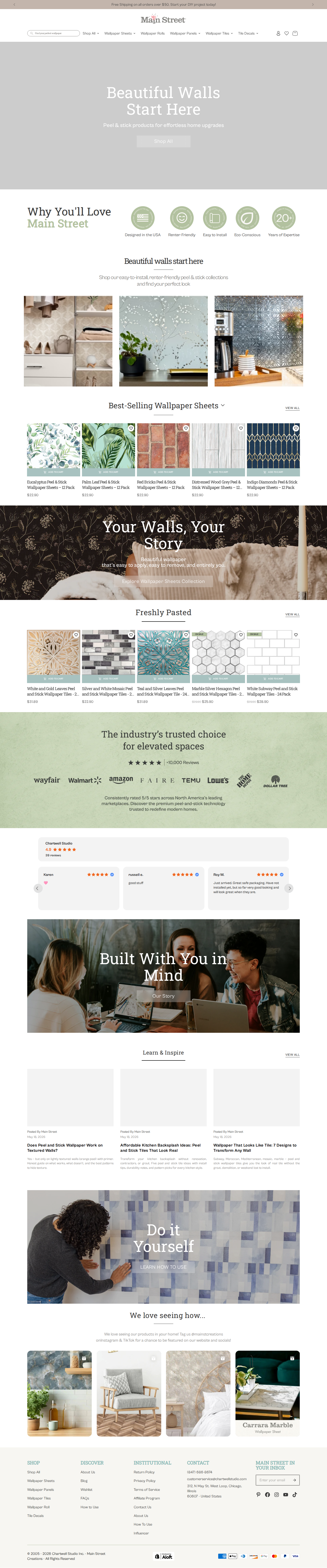
| Homepage | H1 tag is present in the DOM but its text content is empty. The page has no text-bearing H1, which is the most important on-page SEO signal. | Technical | 🔴 Critical | Add meaningful text to the H1 — e.g., "Peel & Stick Wallpaper, Tile Decals & Wall Decor" — inside the theme's hero section Liquid template. |
| Homepage | H2 heading text renders as "Beautiful WallsStart Here" — a text concatenation bug where two separate text nodes are merged without a space. | UX | 🔴 Critical | Inspect the hero section Liquid/HTML and ensure the heading spans are separated by a space or use a single text element. |
| Homepage | Product carousels duplicate the same H3 product names 2–3 times each due to multi-slide rendering, inflating the heading count and confusing crawlers. | Technical | 🟡 Warning | Use aria-hidden="true" on duplicate carousel slides, or switch duplicate slide headings to non-heading elements (e.g., <p> or <span>). |
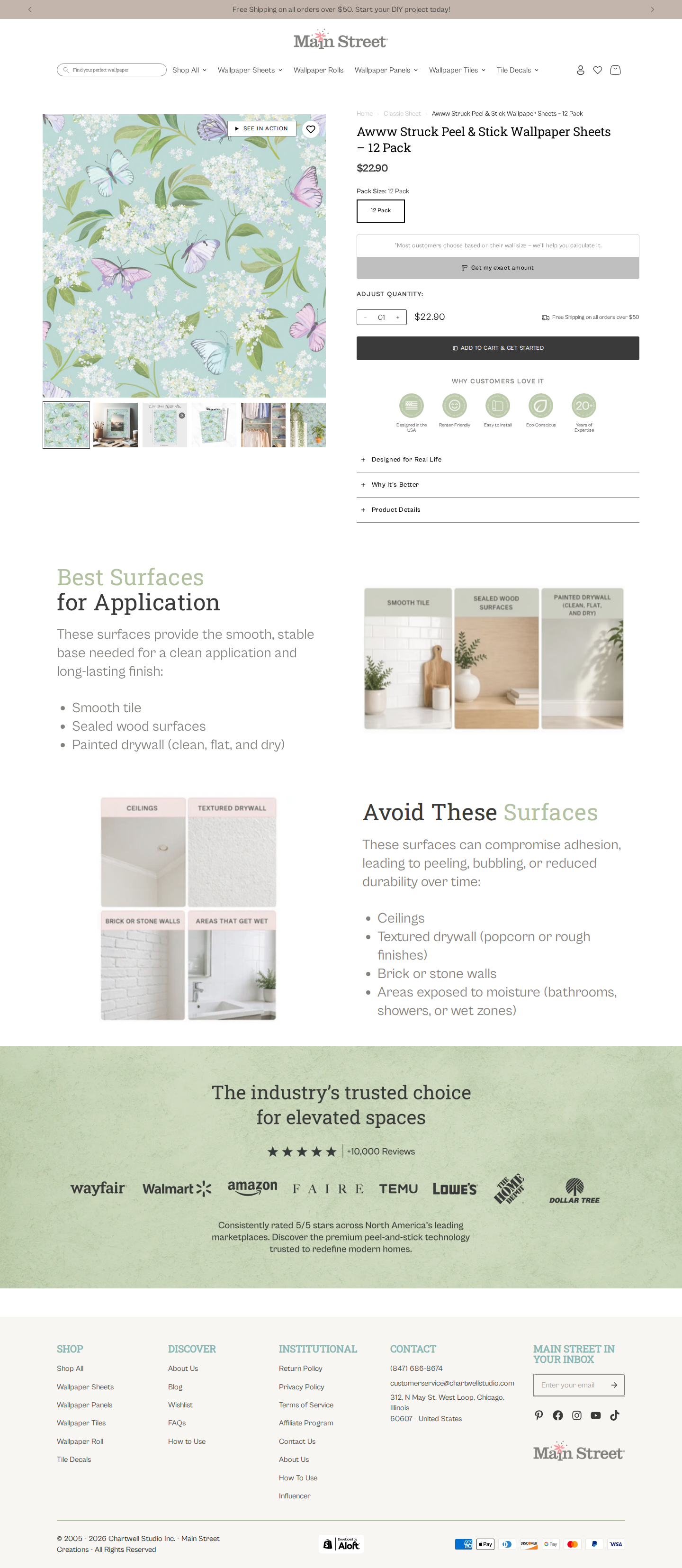
| Product Page | 13 out of 46 images on the product page have empty alt text. This includes product gallery images, which are the most critical for both accessibility and image search indexing. | Technical / GEO | 🔴 Critical | Ensure all product images have descriptive alt text set in Shopify admin. Use the product title + style/color variant as the alt text formula. |
| Product Page | Product schema (JSON-LD) contains no AggregateRating, despite customer reviews appearing in the DOM. Google cannot surface star ratings in search results or AI features. | GEO / Technical | 🔴 Critical | Connect your review app to Shopify's product metafields and ensure it injects AggregateRating into the product JSON-LD, or add it manually via theme customization. |
| Product Page | Product schema is missing GTIN and MPN fields. These identifiers are required for Google Shopping eligibility and help AI systems precisely identify and recommend products. | GEO | 🟡 Warning | Add GTIN/barcode and MPN values to Shopify product metafields, then surface them in the product JSON-LD via theme Liquid. |
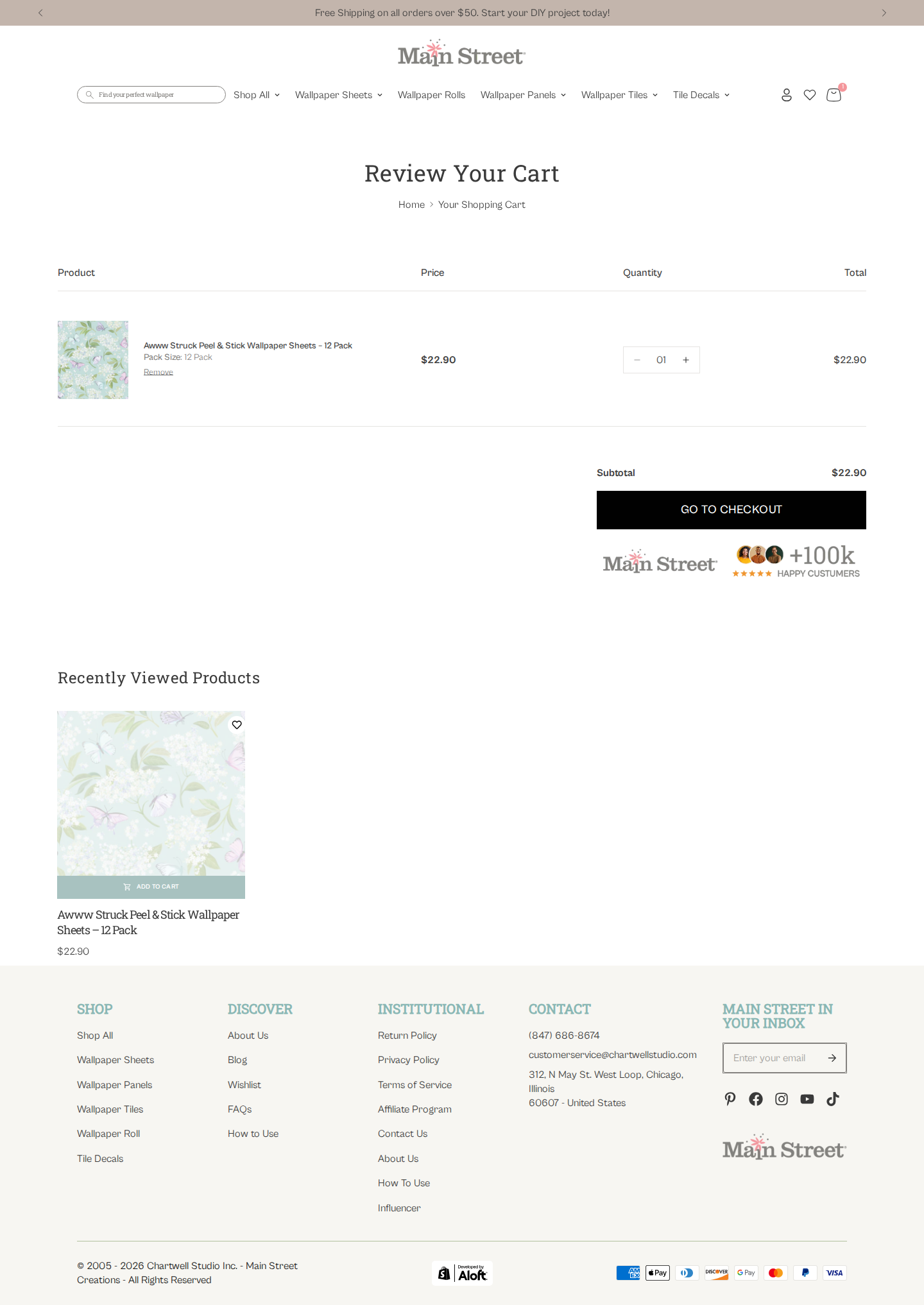
| Cart | Cart page has no free shipping progress bar despite a $50 free shipping threshold. This is one of the highest-ROI cart elements for increasing average order value. | CRO | 🔴 Critical | Add a dynamic progress bar ("Add $X more for free shipping") to the cart drawer and cart page. Minimog theme supports this natively in settings. |
| Cart | No upsell or cross-sell offers visible in the cart. The cart is a missed opportunity to increase order value with complementary product suggestions. | CRO | 🔴 Critical | Enable cart recommendations via Minimog theme settings or install a dedicated cart upsell app. Prioritize complementary product types (e.g., tiles for someone buying sheets). |
| Blog Posts | Blog article pages have no BlogPosting or Article structured data. Google's AI systems can't properly attribute these as expert content pieces from a specific author and brand. | GEO | 🟡 Warning | Add Article schema with author, datePublished, dateModified, publisher (Organization), and headline to all blog post pages via theme Liquid. |
| Product Page | Product FAQ section exists in the DOM but is not exposed as FAQPage schema. These Q&A pairs are prime candidates for Google AI Overviews and People Also Ask features. | GEO | 🟡 Warning | Wrap the FAQ section in FAQPage JSON-LD schema with Question/Answer entities to enable rich result eligibility and AI feature inclusion. |
| Homepage | No <link rel="preload"> tags for the hero/LCP image. With 200 images on the homepage, the Largest Contentful Paint image is likely delayed by not being hinted to the browser early. | Technical | 🟡 Warning | Add fetchpriority="high" to the hero image and a <link rel="preload"> in the <head> to prioritize the LCP image. This directly improves Core Web Vitals. |
| Product Page | No urgency or social proof signals (e.g., "X people viewing now", low stock indicator, or review count) near the Add to Cart button to nudge hesitant shoppers. | CRO | 🟡 Warning | Add star rating + review count directly above the ATC button, and consider a "low stock" or "X sold this week" signal to create purchase urgency. |
| All Pages | No hreflang tags present. If the store ships to Canada and the US (confirmed from checkout country list), duplicate content across locale variants could cause indexing confusion. | Technical | 🔵 Info | If separate market-specific storefronts are not planned, ensure the single domain serves both markets cleanly. If multi-market expansion is planned, implement hreflang. |
| About Page | About page content lacks verifiable third-party citations — no press mentions, awards, retailer partnerships, or external links that would boost entity authority in Google's Knowledge Graph. | GEO | 🟡 Warning | Add a press/as-seen-in section, list retail partners by name, and link to any third-party coverage. This directly builds brand authority for AI systems. |
| Product Page | Product descriptions in JSON-LD are pulled raw from HTML with excessive whitespace and structural markup artifacts instead of clean prose. This reduces their value as AI-readable content. | GEO | 🔵 Info | Strip HTML and normalize whitespace in the JSON-LD description field. Use a clean prose summary of the product rather than the full HTML template output. |
GEO Audit — Generative Engine Optimization
58
/ 100
Main Street has genuine strengths for AI visibility — a real brand story, 20+ years of heritage, a consistent blog, and genuinely advanced agentic commerce infrastructure. The gaps are largely technical: an empty H1 hurts content structure, missing AggregateRating hides social proof from AI systems, and product descriptions need more first-hand expertise to be citation-worthy. Per Google's May 2026 guidance, strong SEO fundamentals are GEO — fixing the structural issues will lift both simultaneously.
9-Dimension Assessment
Non-Commodity Content Quality
Blog articles have good SEO titles and cover real customer questions, but product descriptions lean heavily on specifications (size, coverage, material) rather than first-hand expertise — e.g., "why we chose this material," "how it performs on textured walls," or unique application insights only Main Street could offer. AI systems need non-generic insight to cite.
52
Entity Clarity & Brand Authority
Strong: Jan McCallum's founding story (2003), 20+ year heritage, artist-founded positioning, PVC-free differentiation, and Organization schema with all 5 social profiles. Gaps: no press coverage or retailer mentions on the About page, founding year not in Organization schema, and the brand name "Main Street" is a common phrase — extra entity signals are needed to resolve ambiguity.
72
Technical Crawlability & Indexing
Excellent baseline: all key pages are crawlable, robots.txt is well-structured with no accidental blocks, no nosnippet directives on key pages, Google verification present, and Google Bot/AI crawlers not blocked. The sitemap is accessible. No duplicate content issues detected on visited pages.
85
Content Structure & Semantic HTML
The empty H1 on the homepage is a serious structural failure — it's the primary signal to both users and AI about what the page is. The "Beautiful WallsStart Here" text concatenation bug creates a malformed heading. Carousel duplicate H3s inflate heading counts. Product pages have logical H1 structure. Breadcrumbs are present.
40
Structured Data
Organization, Product, BreadcrumbList, and WebSite schemas are present and largely accurate. Key gaps: no AggregateRating on products despite reviews in the DOM; no GTIN/MPN on products; no Article schema on blog posts; FAQ sections on product pages not wrapped in FAQPage schema. These gaps limit rich result and AI feature eligibility.
58
Multimodal Readiness
Product pages have 7 images each (per schema), which is solid. But 13 images on the audited product page have empty alt text — Google cannot index or understand these images. No video content detected in structured data. Images are Shopify CDN-served (auto-format optimized), which is good. Image filenames appear to be CDN-generated rather than descriptive.
48
Query Fan-Out Readiness
Good foundation: blog articles directly address common customer questions, 3 featured on the homepage, and FAQ sections exist on product pages. The blog titles like "Affordable Kitchen Backsplash Ideas" and "Wallpaper That Looks Like Tile" show awareness of real query patterns. Weakness: FAQ content isn't in FAQPage schema and internal linking within blog articles is sparse.
60
Google Merchant Center & Business Profile
Google Ads conversion tracking (AW-753686065) and Google Tag Manager are active, suggesting some Merchant Center connection. Atom feed (/collections/all.atom) is available as a fallback product feed. However, no Google Merchant Center verification meta tag was detected and product GTINs are missing — both required for optimal Shopping result inclusion and AI product recommendations.
45
Agentic Experience Readiness
Outstanding and ahead of almost all Shopify stores. The robots.txt exposes UCP/MCP endpoints, references an agents.md file, includes llms.txt, and explicitly documents AI agent behavior rules (no auto-checkout, buyer approval required). Shopify Shop.app SKILL.md integration is referenced. The accessibility tree is clean with properly labeled interactive elements. This is genuine future-proofing.
88
Prioritized GEO Actions
| Action | Difficulty | Impact |
|---|---|---|
| Add meaningful text to the homepage H1 tag — e.g., the store's primary value proposition in natural language | Easy | High |
| Connect review app to product JSON-LD to inject AggregateRating schema on all product pages | Medium | High |
| Add descriptive alt text to all product gallery images using the product name + variant/color format | Easy | High |
| Wrap FAQ sections on product pages in FAQPage JSON-LD schema to enable People Also Ask placement | Medium | High |
| Add Article schema to all blog posts with author (Jan McCallum or named author), publisher, and datePublished | Medium | Medium |
| Add GTIN and MPN to product metafields and expose them in the Product JSON-LD for Merchant Center eligibility | Medium | Medium |
| Enrich product descriptions with first-hand expertise: why each material was chosen, performance on different wall types, and application tips unique to Main Street's 20 years of experience | Hard | High |
| Add founding year, founder name, and press/retail citations to the About page and Organization schema to strengthen Knowledge Graph recognition | Easy | Medium |
| Add internal links within blog articles back to relevant product collections and related articles to improve topical clustering | Medium | Medium |
GEO Myths to Ignore
- You don't need to create special AI text files, new Markdown documents, or additional machine-readable formats — Google's guidance explicitly says these are not required for AI feature visibility. Main Street's llms.txt is fine to have, but it is not a ranking signal.
- Do not "chunk" content into tiny fragments for AI consumption — Google's systems understand full pages. Keep product descriptions as complete, well-written prose.
- Do not rewrite content specifically targeting long-tail keyword variations — AI understands synonyms and general meaning. Focus on genuine expertise, not keyword stuffing.
- Do not seek artificial brand "mentions" across low-quality sites — Google's spam systems detect and discount these. Authentic press, retail partnerships, and real customer reviews are what count.
Conversion Rate Optimization
Stage 1
Awareness
62
- Fail Homepage H1 is empty — visitors and search engines receive no primary heading defining what the brand sells or stands for.
- Fail H2 reads "Beautiful WallsStart Here" due to a rendering bug — a trust signal issue visible to real users on every desktop visit.
- Pass Announcement bar prominently states "Rated 5/5 stars" and "Free Shipping on orders over $50" — effective trust signal above the fold.
- Pass Product categories (Wallpaper Sheets, Rolls, Panels, Tiles) clearly organized in the navigation and featured on homepage.
- Pass Blog "Learn & Inspire" section on homepage builds content authority and reduces bounce for research-phase visitors.
- Partial Gamified spin wheel popup (10% off) captures emails but can be intrusive. No A/B test data visible on whether it helps or hurts conversion rate.
Stage 2
Consideration
65
- Pass Collections have working filter and sort functionality. The Wallpaper Sheets collection has a strong meta description and product count is surfaced.
- Pass Product pages have 7 images per product, FAQ accordion sections, breadcrumbs, and a "Complete Your Space" cross-sell section.
- Pass Wallpaper calculator tool on product pages is a high-value conversion aid that reduces buyer uncertainty about quantity.
- Fail No star rating or review count displayed near the Add to Cart button. Social proof is the #1 conversion lever at the point of decision.
- Partial No urgency signals (low stock indicator, "X people viewing," countdown) near the Add to Cart button to prompt immediate action.
- Partial Recently Viewed section present, but no personalized product recommendations based on browsing behavior.
Stage 3
Purchase
52
- Fail Cart page: no free shipping progress bar despite the $50 threshold. Observed directly — the cart with an item added showed no meter or nudge.
- Fail Cart page: no upsell or cross-sell offers. Observed cart has one item and no complementary suggestions — a significant AOV opportunity missed.
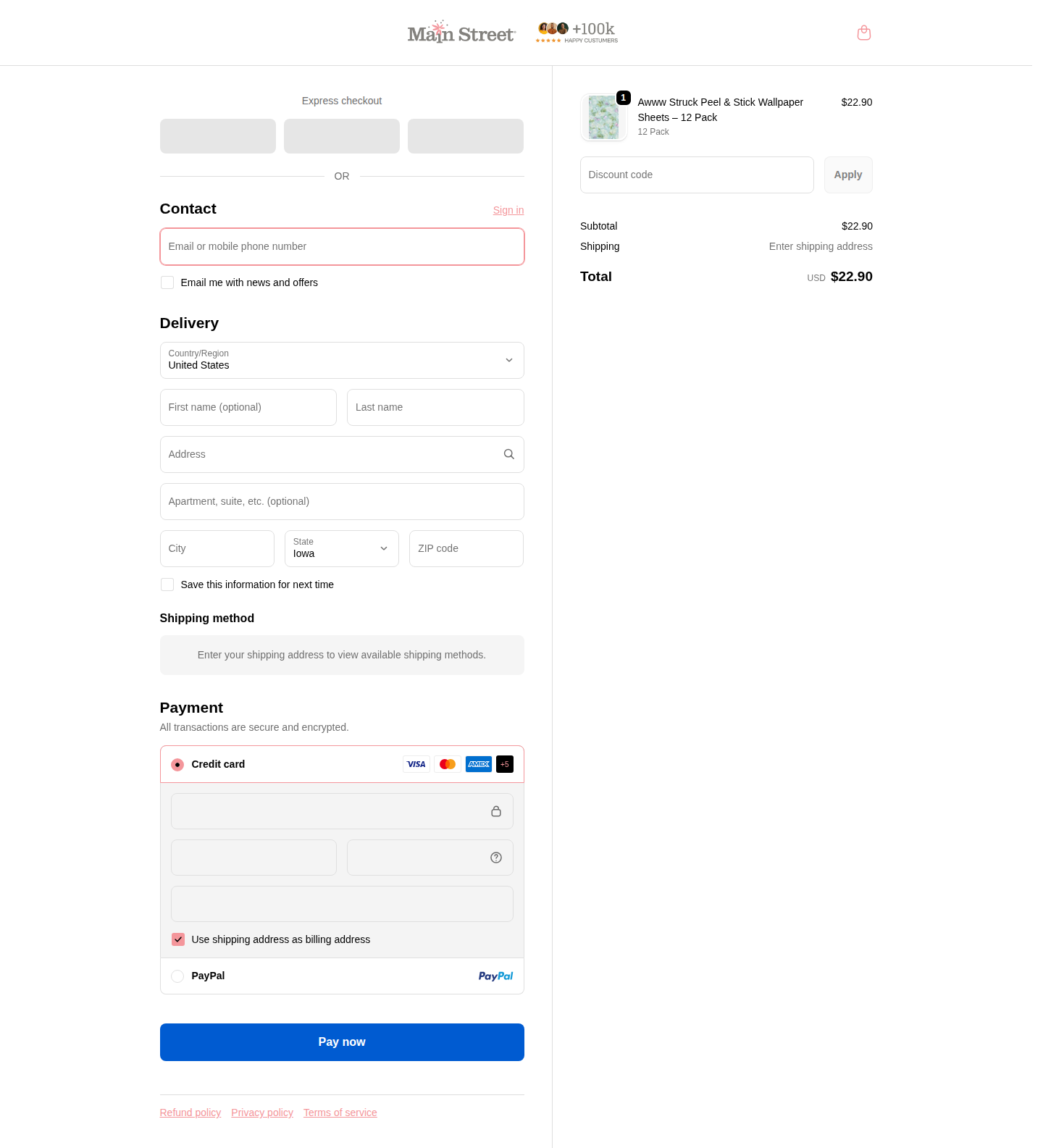
- Pass Checkout uses Shopify native flow with a clear "GO TO CHECKOUT" CTA, express checkout options, and standard Shopify trust infrastructure.
- Pass Checkout observed: Contact, Delivery address (First/Last name, Address, City, State, ZIP), email newsletter opt-in — minimal and clean form fields.
- Pass Checkout supports US and Canada, uses Shopify's new Customer Accounts (unified login via shopify.com), and offers modern payment UX.
- Partial WELCOME10 (10% off) is shown in the announcement bar but is not auto-applied at checkout — creating friction for users who forget the code.
Stage 4
Retention
48
- Pass Email newsletter signup present with 10% first-order discount as an incentive — solid lead capture for repeat purchase nurturing.
- Pass Active presence on 5 social platforms (Instagram, Facebook, Pinterest, YouTube, TikTok) — strong multi-channel retention potential.
- Pass Blog with 48 articles supports ongoing organic engagement and provides reasons for customers to return to the site.
- Fail No loyalty or rewards program detected. For a repeat-use product category (customers redecorate multiple rooms over time), this is a significant retention gap.
- Fail No post-purchase upsell flow detected. The period immediately after checkout is the highest-converting upsell moment — currently unused.
- Partial Wishlist feature available via navigation, which helps with deferred purchase intent, but no price drop or back-in-stock alert functionality visible.
App Stack Audit
| App / Integration | Purpose | Performance Impact | Est. Cost/mo | Verdict | Potential Savings |
|---|---|---|---|---|---|
| Minimog Theme (Fox Kit) | Premium Shopify theme with built-in wishlist, mega menu, cart drawer, product tabs, and animations | Medium | ~$18/mo (updates plan) | Keep | — |
| Microsoft Clarity | Behavioral analytics — session recordings, heatmaps, rage-click detection | Low | Free | Keep | — |
| AWIN Affiliate Integration | Affiliate network tracking (publisher ID 126605) — enables publisher-driven traffic and commission-based sales | Low | ~$30/mo + commissions | Keep | — |
| Google Ads + GTM | Conversion tracking (AW-753686065), remarketing, and Google Tag Manager container | Low | Free (ad spend separate) | Keep | — |
| Meta (Facebook) Pixel | Facebook/Instagram retargeting and audience building (Pixel ID: 880033339106031) | Low | Free (ad spend separate) | Keep | — |
| Gamified Popup (Spin Wheel) | Spin-to-win wheel offering 10% off first order — email capture and first-visit conversion incentive | Medium | ~$15–30/mo | Evaluate | Up to $30/mo |
| Cart Upsell App | Not installed. No cross-sell or upsell in the cart was observed — a significant missing component for a multi-SKU wallpaper store | Low | ~$10–30/mo | Add | +Revenue |
| Post-Purchase Upsell App | Not installed. No post-purchase offer detected. ReConvert or similar could add 5–15% to AOV with zero friction to the initial checkout | Low | ~$5–25/mo | Add | +Revenue |
| Loyalty & Rewards App | Not installed. No loyalty program visible. For a repeat-purchase category, Smile.io or Growave would meaningfully improve retention metrics | Low | ~$0–49/mo | Add | +LTV |
| Potential Savings (spin wheel evaluation) | Up to $30/mo / $360/yr | ||||
App Strategy Recommendation
Main Street's app stack is lean and well-structured — most detected integrations are either free or revenue-generating. The biggest opportunity is not removal, it's addition: a cart upsell app and a post-purchase upsell flow are the two highest-ROI additions for a store at this stage. If the spin wheel popup isn't showing a positive ROI in email revenue vs. its impact on bounce rate, consider replacing it with a simpler exit-intent or scroll-triggered offer that's less disruptive to first-time visitors.
Theme & Code Quality
Theme Name
Minimog by Fox Kit
Asset version t/19 · Confirmed from MinimogTheme JS namespace
Code Health Score
68/100
Technical Debt
- Critical Empty H1 in theme template — the homepage hero section has an H1 element but its Liquid/HTML content evaluates to empty. This is a theme template bug requiring a fix in the section's Liquid code or theme editor settings.
- Critical Text concatenation bug in H2 — "Beautiful WallsStart Here" has adjacent text nodes joining without whitespace. Likely caused by split span elements in the theme template for animation purposes. A non-breaking space or CSS-driven animation approach would fix this.
- Warning 53 JavaScript files loaded — all are async/deferred (good), but 53 is a high count. Each file represents an HTTP request. Consider auditing the Minimog FoxKit feature set to disable unused features and reduce the JS payload.
-
Warning
No LCP image preloads — 200 images were detected on the homepage (including all carousel slides), but none have
<link rel="preload">hints. The hero image should be preloaded to improve Largest Contentful Paint and Core Web Vitals scores. - Warning Duplicate product headings from carousels — the Minimog Swiper carousel renders multiple clones of product card H3 headings in the DOM. These should use aria-hidden="true" on non-active slides to avoid confusing crawlers with repeated heading content.
- Info Page transition animation — Minimog's fade-in/fade-out page transition effect (m-page-transition) adds a brief white screen on every navigation. While visually polished, this can marginally delay perceived performance and should be tested for impact on conversion rate.
- Info Custom font (M-Body-Font) — a custom proprietary font system is used rather than a standard web font. Ensure proper WOFF2 preloading is in place to avoid font-swap layout shift affecting CLS (Cumulative Layout Shift) scores.
Brand Identity
Logo

Color Palette
#c3b5ac
Brand Accent / Warm Taupe
#3a3a3a
Primary Text / Buttons
#ffffff
Background / Canvas
#f0ebe8
Background Tint / Warm Cream
Brand Consistency Assessment
Typography
GoodCustom brand font (M-Body-Font) applied consistently. Clean, readable typographic hierarchy across pages.
Color Consistency
GoodWarm taupe announcement bar, white body, dark text buttons — palette applied uniformly across all visited pages.
Imagery Style
GoodClean, lifestyle-forward product photography. Consistent bright, airy aesthetic that matches the premium positioning.
Tone of Voice
Needs WorkApproachable but could be more distinct. Product names like "Awww Struck" and "Blossoms and Besties" are charming; product descriptions could better reflect Jan McCallum's artist voice.
Brand Story Visibility
Needs WorkThe 2003 founding story and artist origin are on the About page but not surfaced on product pages, homepage hero, or in product descriptions — leaving the most visited pages without this differentiator.
Logo Legibility
ExcellentSVG format, readable on both light and dark backgrounds. Appropriately sized in the header. Favicon is a distinct "M" mark.
Growth Roadmap
Fix & Activate
- Add meaningful text to the homepage H1 — this single change directly improves SEO rankings and AI snippet eligibility for the store's most important page.
- Fix the "Beautiful WallsStart Here" heading by adding a space between text nodes in the hero section Liquid template.
- Enable the free shipping progress bar in the cart drawer via Minimog theme settings (this feature is built into Minimog — it just needs to be activated and configured for the $50 threshold).
- Add descriptive alt text to all product gallery images via Shopify admin. Use format: "[Product Name] — [Color/Style] Peel & Stick Wallpaper" for consistency.
- Add the founding year (2003) and founder name (Jan McCallum) to the Organization JSON-LD to strengthen Knowledge Graph recognition for the brand entity.
Build & Optimize
- Connect the review app to product JSON-LD to inject AggregateRating schema. This unlocks star ratings in Google search results and AI product recommendations — potentially the single biggest traffic quality improvement available.
- Add FAQPage schema to all product pages wrapping the existing FAQ accordion content. These Q&A pairs are prime candidates for Google AI Overviews and People Also Ask placement.
- Install a cart upsell app (Rebuy, UpCart, or Minimog's native cross-sell settings) to surface complementary product suggestions in the cart. For a multi-SKU wallpaper store, this could meaningfully increase average order value.
- Install a post-purchase upsell app (ReConvert or AfterSell) to capture AOV lift immediately after checkout without disrupting the main purchase flow.
- Add Article schema with author, datePublished, and publisher to all blog post templates. This attributes expert content to the brand entity in Google's knowledge systems.
- Add GTIN/barcode values to all products via Shopify metafields and expose them in the Product JSON-LD for Google Shopping eligibility and AI product matching.
Grow & Lead
- Rewrite product descriptions to incorporate first-hand expertise: WHY each material was chosen, HOW designs perform in real-world scenarios, and WHAT makes Main Street's curation different from mass-market alternatives. Jan McCallum's painter perspective is a genuine differentiator — put it in product copy.
- Build out a press/media page and add an "As Seen In" section to the About page and homepage. Seek press coverage from home decor publications, list retail partnerships by name, and link to any existing coverage. This directly builds entity authority for AI systems.
- Launch a loyalty program (Smile.io or Growave) targeting repeat customers. Wallpaper is a repeat-purchase category — customers who redecorated a bathroom will redecorated a bedroom next year. Make them feel rewarded for choosing Main Street twice.
- Create a verified Google Merchant Center account with complete product feeds (including GTINs, accurate pricing, and high-quality images) to maximize inclusion in Google Shopping AI recommendations and Product Listing Ads.
- Add internal linking within blog articles to relevant collection pages and related articles. The 48 blog articles are underperforming as a traffic driver because they don't effectively funnel readers toward purchase.